MODERN BJJ BELT REQUIREMENT: A COMPLETE TECHNICAL CURRICULUM!
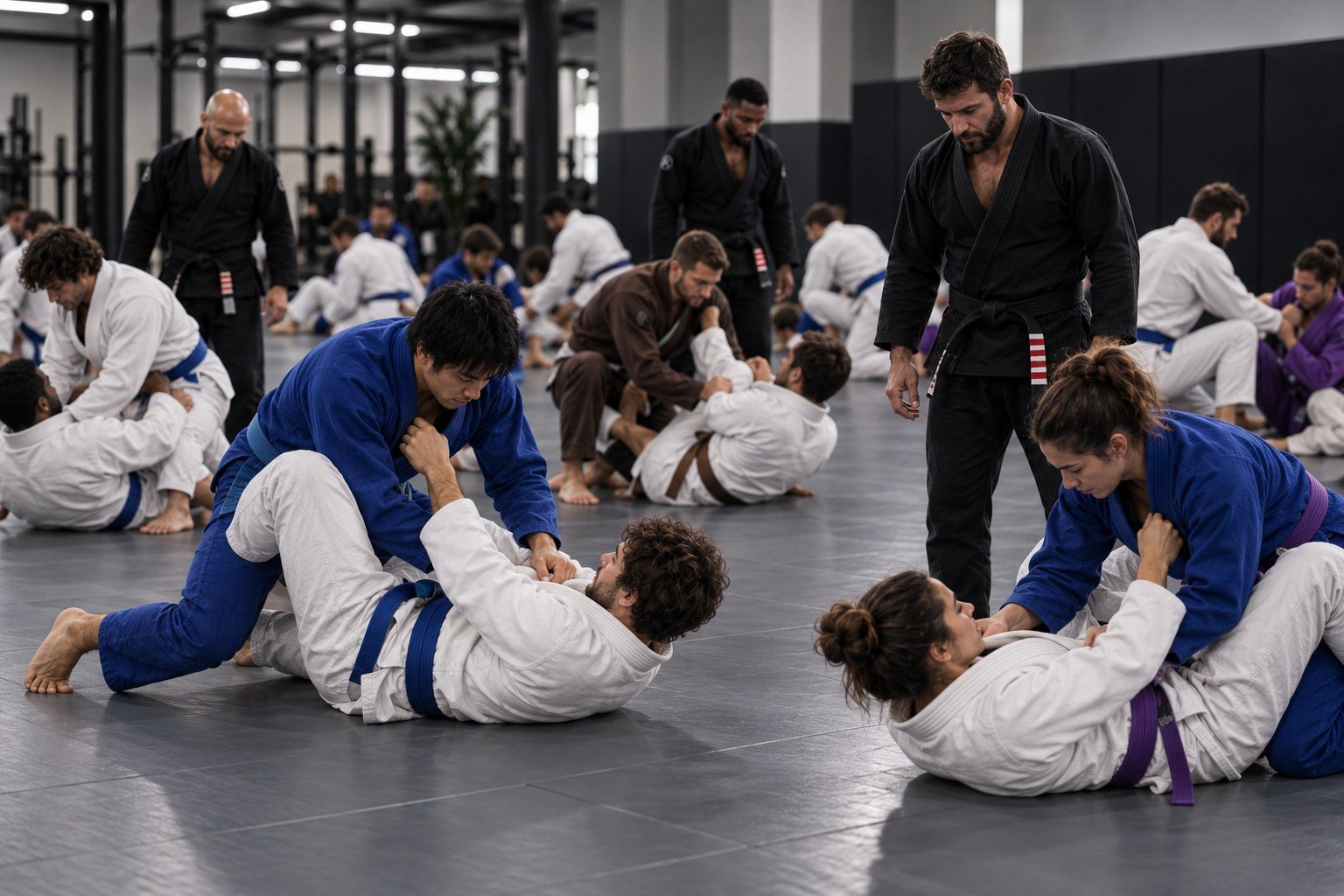
A modern Brazilian Jiu-Jitsu curriculum should cover standing grappling, guard work, passing, pins, escapes, submissions, leg entanglements, and the transitions connecting them. Each promotion should reflect the ability to apply those skills against resistance.
This suggested adult curriculum covers both gi and no-gi training. It provides an academy framework, rather than an official universal checklist. Instructors should adapt it to their students, training environment, and program goals.
Requirements are cumulative: a brown belt remains responsible for the foundational skills expected of a blue belt.
What Each Belt Promotion Should Represent
Suggested technical expectations by promotion| Promotion | Main Technical Expectation |
|---|---|
| White to Blue | Function safely and competently in every major position. |
| Blue to Purple | Connect techniques into reliable offensive and defensive systems. |
| Purple to Brown | Solve advanced problems and develop a complete personal game. |
| Brown to Black | Demonstrate depth, adaptability, efficiency, and sound technical judgment. |
| Ongoing Black Belt Development | Refine, expand, troubleshoot, and transfer knowledge. |
Students should recognize every major technique family, develop functional competence across positions, and demonstrate deeper skill in techniques suited to their bodies and games. Equal mastery of every named variation is not a practical promotion standard.
1. White Belt to Blue Belt
Technical standard: The student can protect themselves, escape common bad positions, establish useful positions, and apply a small, connected offense.
Movement, Contact, and Defensive Fundamentals
- Backward and sideways breakfalls.
- Forward rolls and shoulder rolls where physically appropriate.
- Technical stand-up with distance management.
- Bridging and hip escapes.
- Sit-outs and hip heists.
- Transitions between supine, seated, kneeling, and standing positions.
- Pummeling for inside position with arms and legs.
- Frames at the shoulder, hip, and biceps.
- Recovery of elbow–knee connection.
- Maintaining base against pushes, pulls, and rotational pressure.
- Understanding frames, grips, hooks, wedges, and posts.
- Recognition of exposed necks, extended arms, and trapped knees.
Standing Grappling
- Functional gi and no-gi stances.
- Movement without crossing the feet or overreaching.
- Level changes and penetration steps.
- Collar ties, wrist control, inside ties, and underhooks.
- Basic gi collar-and-sleeve grip fighting.
- Single-leg takedown with a basic finish.
- Double-leg takedown with a basic finish.
- Body-lock takedown or controlled outside trip.
- One foot sweep or inside trip.
- Snapdown to front headlock.
- Sprawl and recovery to a useful position.
- Basic single-leg defense using balance, a whizzer, and leg clearing.
- Guard pull with controlled contact.
- Standing safely from seated guard.
- Controlled mat return without slamming.
Escapes and Defensive Recovery
Mount
- Trap-and-roll escape.
- Elbow–knee escape.
- Recovery to half guard.
- Defense against high mount and arm isolation.
Side Control
- Frame and hip escape to guard.
- Underhook escape to the knees.
- Recovery of inside knee position.
- Prevention of crossface and underhook consolidation.
Other Pins
- North–south escape to a side-facing recovery.
- Knee-on-belly escape.
- Scarf-hold escape appropriate to the opponent’s grip.
- Reverse-scarf recovery.
Back Control
- Neck protection and hand fighting.
- Hook clearing.
- Moving the shoulders toward the mat.
- Escape direction based on the opponent’s control.
- Basic body-triangle recognition and defense.
Turtle and Front Headlock
- Protection of the neck and inside space.
- Sit-out or turn-in recovery.
- Guard recovery from turtle.
- Front-headlock hand fighting and posture recovery.
Guard Retention and Recovery
- Seated and supine defensive positioning.
- Useful foot, shin, and hand contact.
- Tracking the passer with the hips and legs.
- Recovery of inside position after a leg is displaced.
- Defense against basic outside passing.
- Defense against basic knee-cut passing.
- Defense against basic stack pressure.
- Open-guard recovery to half guard.
- Half-guard recovery to a fuller guard.
- Standing when the opponent disengages.
- Recognition of when to frame, retreat, turn, or wrestle up.
Guard Attacks
Closed Guard
- Posture breaking and posture control.
- Hip-bump sweep.
- Scissor sweep.
- Pendulum or flower sweep.
- Arm drag to the back.
- Overhook and underhook control.
- Basic stand-up response when the opponent opens the guard.
Half Guard
- Knee-shield structure.
- Underhook half guard.
- Side positioning and prevention of flattening.
- Knee-tap or basic underhook sweep.
- Recovery to closed or butterfly guard.
Butterfly and Seated Guard
- Establishing hooks and upper-body connection.
- Basic butterfly sweep.
- Arm drag.
- Coming up on a single leg.
Open Guard
- Basic collar-and-sleeve control in gi.
- Basic shin-to-shin connection.
- Basic tripod sweep.
- Recognition of single-leg X and its off-balancing function.
Guard Passing
- Standing closed-guard opening.
- Safe kneeling closed-guard opening.
- Posture maintenance and arm protection.
- Toreando or bullfighter pass.
- Knee-cut pass.
- Basic over-under or double-under pass.
- Basic half-guard pressure pass.
- Butterfly-hook clearing.
- Hip control after clearing the legs.
- Side-control consolidation before advancing.
Pins and Positional Advancement
- Side control with crossface and underhook.
- Transitions between side control, scarf hold, and north–south.
- Knee-on-belly control.
- Low and high mount.
- Technical mount.
- Seatbelt and basic back control.
- Hook maintenance without crossing the feet.
- Side control to mount.
- Mount to back control.
- Turtle to back control.
- Control recovery when the opponent bridges or turns.
Submissions
Upper-Body Submissions
- Rear naked choke.
- Armbar from mount.
- Armbar from closed guard.
- Triangle from guard.
- Kimura from guard and side control.
- Americana from top.
- Arm-triangle choke.
- Basic guillotine.
- Omoplata recognition and basic application.
Gi Submissions
- Cross-collar choke from guard.
- Cross-collar choke from mount.
- Basic collar choke from the back.
- Basic bow-and-arrow choke.
Lower-Body Submissions and Control
- Straight ankle lock.
- Basic straight-ashi control.
- Recognition of a trapped knee line.
- Safe disengagement from basic leg entanglements.
Submission Defense
- Early armbar defense and elbow recovery.
- Triangle posture and angle prevention.
- Kimura grip and shoulder-position defense.
- Rear naked choke hand fighting.
- Guillotine prevention and positional escape.
- Arm-triangle framing and positional recovery.
- Straight ankle-lock defense and knee-line recovery.
- Recognition of secured submissions and prompt tapping.
Promotion evidence: The student can escape, retain guard, pass, control, and attack during live work against appropriately matched resistance.
2. Blue Belt to Purple Belt
Technical standard: The student can create reactions, link attacks, and continue working when the first option fails.
Standing Systems
- Grip fighting leading directly to attacks.
- Single-leg finish variations.
- Double-leg transitions when the single leg is defended.
- Single-leg, double-leg, and body-lock combinations.
- Snapdown, go-behind, and front-headlock combinations.
- Arm drag to rear body lock.
- Underhook and overhook takedown options.
- Foot sweep to trip or takedown combinations.
- Front-headlock defense into reattack.
- Single-leg defense into counterattack.
- Guard pull to immediate sweep or attack.
- Wrestle-up finishes from seated and half guard.
Advanced Escapes
- Linked mount escapes based on weight distribution.
- High-mount and technical-mount escapes.
- Side-control escapes against crossface and underhook pressure.
- Hip-switch and reverse-scarf escapes.
- Back escapes against stronger seatbelt control.
- Body-triangle escape strategies.
- Turtle recovery against spiral rides and breakdowns.
- Front-headlock escapes against guillotine, D’Arce, and anaconda threats.
- Early and late submission-defense distinctions.
- Escapes that lead directly into offense.
Guard Retention
- Defense against knee cuts, toreandos, leg drags, and stacks.
- Recovery against pressure and mobile passing.
- Transitions between seated and supine guard.
- Leg pummeling against outside passing.
- Shoulder-based recovery or inversion where appropriate.
- Non-inverting solutions to the same recovery problems.
- Back-exposure prevention during retention.
- Guard recovery into sweeps or wrestle-ups.
Guard Systems
Closed Guard
- Arm-drag and back-take sequences.
- Overhook attacks.
- Clamp or shoulder-control positions.
- Hip bump to kimura to triangle.
- Armbar to triangle to omoplata.
- Responses to standing opponents.
Half Guard
- Knee-shield offense.
- Underhook and dogfight systems.
- Knee tap, far-knee attack, and roll-under options.
- Half-butterfly sweeps.
- Deep-half introduction.
- Kimura attacks.
- Responses to the whizzer, crossface, and backstep.
Butterfly Guard
- Sweeps in both directions.
- Shoulder-crunch control.
- Arm drags and back exposure.
- Transitions to single-leg X.
- Transitions to X-guard.
- Transitions to wrestle-ups.
Open Guard
- Collar-and-sleeve attacks.
- Spider and lasso fundamentals in gi.
- De La Riva fundamentals.
- Reverse De La Riva fundamentals.
- Shin-to-shin to single-leg X.
- Single-leg X sweeps.
- X-guard sweeps and technical stand-ups.
- K-guard recognition and basic entry.
- Connections between outside and inside guard positions.
Passing Systems
- Knee-cut combinations.
- Headquarters positioning.
- Toreando to leg drag.
- Leg drag to back exposure.
- Long-step passing.
- Over-under passing.
- Body-lock passing fundamentals.
- Half-guard passing against knee shield and underhook.
- Butterfly-guard passing.
- Single-leg X and X-guard passing.
- Basic spider and lasso grip clearing.
- Switching between outside, through-the-legs, and pressure passing.
- Reconnecting after the opponent recovers guard.
Pins, Rides, and Back Control
- Prevention of underhook recovery.
- Near-arm and far-arm isolation.
- Mount advancement through elbow separation.
- Gift-wrap control.
- S-mount.
- Chair sit to back control.
- Back control with hooks and body triangle.
- Basic arm trapping from the back.
- Turtle breakdowns using wrist, waist, and hip control.
- Basic crucifix entry and control.
- Mat returns from rear body lock.
- Following turns while maintaining chest-to-back connection.
Submission Systems
- Rear naked choke against active hand fighting.
- Back choke to armbar.
- Armbar, triangle, and omoplata combinations.
- Kimura connections to sweeps, back takes, and armbars.
- Arm triangle from multiple top positions.
- Guillotine variations, including arm-in and high-elbow recognition.
- D’Arce choke.
- Anaconda choke.
- North–south choke.
- Mounted triangle.
- Gi loop choke.
- Gi baseball-bat choke.
- Gi clock choke.
- Wrist-lock recognition and controlled application where permitted.
Leg-Entanglement Literacy
- Straight ashi.
- Outside ashi.
- Cross ashi or saddle recognition.
- 50/50.
- Basic backside-entanglement recognition.
- Straight ankle-lock variations.
- Entries from single-leg X and butterfly guard.
- Basic kneebar and toe-hold mechanics in an appropriate training setting.
- Inside and outside heel-hook recognition.
- Heel exposure, knee-line control, and rotational danger.
- Hand fighting, heel hiding, and disengagement.
- Leg attacks connected to sweeps and passes.
Promotion evidence: The student has a connected guard game, passing game, escape system, and submission game, and can adjust to common defensive reactions.
3. Purple Belt to Brown Belt
Technical standard: The student has broad technical competence and a dependable personal game that survives sophisticated resistance.
Standing and Wrestling Integration
- Chained takedowns across multiple reactions.
- Reattacks after defended shots.
- Single-leg finishes against hopping, whizzers, and grounded defense.
- Front-headlock attacks linked with go-behinds.
- Body-lock takedowns and controlled mat returns.
- Trips and foot sweeps from multiple grips.
- Counter-wrestling against common shots.
- Wrestling through scrambles.
- Guard pulls with immediate offensive connection.
- Standing-to-passing transitions without unnecessary disengagement.
- Wrestle-up to finish to stabilized top position.
Advanced Guard Retention and Escapes
- Retention against combined passing styles.
- Recovery from nearly completed passes.
- Defense against leg pins and hip immobilization.
- Recovery from chest-to-chest half guard.
- Body-lock passing defense.
- Leg-drag and back-exposure defense.
- Late positional recovery with submission awareness.
- Escapes from advanced mount and back-control systems.
- Recovery from rides, flattened turtle, and crucifix threats.
- Conversion of defensive reactions into attacks.
Advanced Guard Systems
Students should demonstrate deep competence in selected systems and functional answers to the others.
- Closed guard against standing and kneeling opponents.
- Shoulder-crunch and clamp-guard attacks.
- Knee shield, dogfight, half-butterfly, and deep half.
- Butterfly and seated-guard dilemmas.
- Single-leg X and X-guard combinations.
- De La Riva and reverse De La Riva.
- Collar-and-sleeve, spider, and lasso systems.
- K-guard entries and follow-ups.
- Waiter-position sweeps.
- 50/50 sweeps, disengagement, and passing.
- Choi-bar and armbar entries from suitable guard configurations.
- Berimbolo and crab-ride recognition, defense, and selected applications.
- Underhook De La Riva recognition.
- Lapel-guard recognition, grip clearing, and selected applications.
- Entries to backside leg entanglements.
- Guard to wrestle-up to back take.
- Guard to leg attack to sweep to pass.
Advanced Passing
- Outside passing with angle changes and reattacks.
- Knee-cut systems against layered frames.
- Body-lock passing against active hooks and underhooks.
- Half-guard passing with crossface, underhook, and hip control.
- Backstep and reverse-half passing.
- Smash and folding passes.
- Float passing and leg pummeling.
- Forcing half guard from open guard.
- Seated-guard passing while managing shot exposure.
- Gi-guard passing through deliberate grip removal.
- Passing 50/50 and leg entanglements.
- Submission defense during passing.
- Creating back exposure as an alternative to a conventional pass.
Advanced Pins and Rides
- Chest-to-chest and chest-to-back control.
- Separation of elbows from the torso.
- Near-side and far-side arm isolation.
- Mount systems built around arm exposure.
- Back-control systems built around hand-fighting advantages.
- Straightjacket-style arm trapping.
- Cross-body rides and leg rides.
- Wrist rides and spiral rides.
- Turtle breakdowns against active stand-ups.
- Crucifix control and transitions.
- Pin switching in response to escape attempts.
- Control maintenance during submission entries.
Advanced Submission Systems
- Multiple rear naked choke finishing configurations.
- Choke-to-armbar transitions from the back.
- Armbar finishing against connected hands and defensive stacks.
- Triangles from guard, mount, side, and back-related positions.
- Kimura-trap systems across top, bottom, and scrambles.
- Omoplata finishing, sweeping, and reattacking.
- Guillotine systems against multiple defensive responses.
- D’Arce, anaconda, and guillotine combinations.
- North–south choke finishing adjustments.
- Arm-triangle finishing and escape counters.
- Gi collar-choke combinations.
- Lapel-assisted attacks appropriate to the student’s game.
- Submission transitions that preserve positional control.
Advanced Leg Locks
- Straight ankle-lock systems.
- Inside and outside heel-hook systems in an appropriate setting.
- Kneebar systems.
- Toe-hold systems.
- Calf-slicer recognition and selected applications.
- Transitions between straight ashi and outside ashi.
- Cross-ashi or saddle control.
- 50/50 and backside-50/50 relationships.
- Secondary-leg control.
- Separation and control of the opponent’s legs.
- Heel exposure against defensive foot positioning.
- Counter-leg-lock awareness.
- Knee-line recovery against layered control.
- Coming on top when submission opportunities disappear.
- Leg attacks connected to back takes and guard passes.
Counter Systems
- Underhook counters using front-headlock threats or back exposure.
- Kimura defense and counters.
- Wrestle-up defense and counters.
- Rolling back-take defense.
- Berimbolo and crab-ride defense.
- Counters to leg entries during passing.
- Recognition of baited submissions and positional traps.
- Immediate reattacks after successful defense.
Promotion evidence: The student can impose a coherent game, solve unfamiliar problems, and remain technically functional outside their preferred positions.
4. Brown Belt to Black Belt
Technical standard: The student can consistently organize the full exchange—entry, control, reaction, transition, finish, and recovery—with technical judgment.
Promotion at this stage should depend heavily on the depth and integration of the cumulative curriculum. Adding obscure techniques does little to establish black-belt competence.
Complete Standing-to-Ground Systems
- Create preferred grips or ties against resistance.
- Force predictable reactions.
- Chain takedowns and counter-takedowns.
- Distinguish realistic finishes from failing attacks.
- Recover safely after failed shots.
- Connect takedowns directly to passes, pins, or back control.
- Connect guard pulls directly to offense.
- Integrate standing, seated, and grounded wrestling.
Complete Defensive Systems
- Multiple credible escape routes from every major pin.
- Escape selection based on the opponent’s control.
- Defense against chained submissions.
- Guard retention against contrasting passing styles.
- Leg-lock defense against connected entanglement systems.
- Recovery after losing the first and second defensive layers.
- Technical responses to unfamiliar grips and configurations.
- Recognition of escape attempts that create excessive exposure.
Complete Bottom Game
- Reliable offense against standing and kneeling opponents.
- Effective responses to pressure and disengagement.
- A dependable primary guard system.
- Complementary guards covering the primary system’s weaknesses.
- Sweeps in multiple directions.
- Submission threats that create sweeps and back takes.
- Wrestle-ups when connections favor standing.
- System changes when preferred grips are denied.
- Gi and no-gi adaptations within the academy’s scope.
Complete Top Game
- Reliable entry into passing range.
- Passing against inside-position and outside-position guards.
- Effective loose and pressure-passing options.
- Answers to leg attacks during passing.
- Consolidation after passing.
- Pin transitions that follow realistic escape attempts.
- Arm isolation and back exposure.
- Submission entry without routinely surrendering control.
- Recovery when the opponent escapes or reverses.
Complete Submission Game
- Reliable finishing mechanics in primary submission families.
- Multiple entries to preferred submissions.
- Responses to common and advanced defenses.
- Recognition of control problems versus finishing problems.
- Abandonment of failing submissions while preserving advantage.
- Effective attacks on the neck, upper limbs, and lower limbs.
- Competent defense against those same attack families.
- Controlled application appropriate to the partner and training rules.
Technical Troubleshooting
- Identify why an entry fails.
- Identify missing connections or controls.
- Adjust angle, alignment, grip, pressure, or timing.
- Explain the opponent’s available defensive options.
- Build a second attack around the most likely defense.
- Recognize techniques poorly matched to the situation.
- Adapt techniques to different body types and mobility limits.
- Distinguish mechanical problems from decision-making problems.
Personal-Game Depth
A black-belt candidate should demonstrate complete sequences such as:
- Standing: tie-up → takedown → defensive reaction → secondary finish → top control.
- Guard: connection → off-balance → sweep threat → submission or wrestle-up.
- Passing: entry → first pass → recovery response → second pass → pin.
- Back: entry → retention → arm trap → choke → secondary finish.
- Leg locks: entry → entanglement → defensive reaction → transition → submission or top position.
- Defense: prevent → escape → recover → counterattack.
Promotion evidence: The student shows broad competence, deep specialization, adaptable decision-making, and controlled execution against meaningful resistance. Assessment should account for age, size, physical capacity, and training partners.
5. Ongoing Black-Belt Technical Development
Technical development continues after black belt. Continued expectations can include:
- Refining weaker positions.
- Updating defenses against emerging attacks.
- Developing alternative systems as physical abilities change.
- Improving finishing efficiency.
- Reducing unnecessary movement and force.
- Building answers to opponents who understand the primary game.
- Testing technical claims through live practice.
- Explaining mechanisms and troubleshooting accurately.
- Helping students develop solutions to positional problems.
- Maintaining familiarity with developments in gi and no-gi.
Teaching skill can be evaluated separately from competitive performance. Excellence in one does not automatically establish excellence in the other.
Which Modern Techniques Should Be Mandatory?
A useful curriculum distinguishes essential competence from optional specialization. Students need answers to major positional problems, while their preferred solutions can differ.
Core competence and specialization| Technical Area | Recommended Expectation |
|---|---|
| Pin escapes, guard retention, passing, and back control | Functional competence for everyone. |
| Standing grappling and wrestle-ups | Functional competence adapted to physical capacity. |
| Closed, half, butterfly, and open guard | Broad competence with depth in selected systems. |
| Straight ankle locks and basic entanglement defense | Foundational literacy. |
| Heel hooks and rotational leg-lock defense | Progressive supervised literacy; application depends on training scope. |
| K-guard, advanced X-guard, and backside entries | Recognition and defense; specialization varies. |
| Berimbolo, crab ride, and advanced inversion | Recognition and defense; execution can be optional. |
| Spider, lasso, and lapel guards | Relevant technical literacy for a gi curriculum. |
| Rubber guard and flexibility-dependent systems | Optional specialization. |
| Flying submissions and highly acrobatic entries | Optional specialization. |
| Neck cranks and spinal locks | Separate ruleset-specific material. |
Training knowledge and competition legality must be tracked separately. Learning a technique does not make it legal in every division. Confirm the applicable rules for the athlete’s age, belt, uniform, and event before competition.
Assessing Technical Requirements Through Live Work
Each curriculum item can be assessed through representative live tasks. A student’s ability to demonstrate a movement is one part of the assessment; using it against an opponent’s changing actions establishes its practical value.
Five dimensions of technical assessment| Assessment | What the Student Must Demonstrate |
|---|---|
| Recognition | Identify the position, threat, and useful options. |
| Execution | Apply the technique with appropriate control. |
| Resistance | Make it work against an actively resisting partner. |
| Adaptation | Change the action when the opponent changes the problem. |
| Connection | Continue into another useful action when the first attempt fails. |
For example, knowing the knee-cut pass should mean the student can establish the necessary control, respond to a knee shield or underhook, complete the pass, and stabilize. When the opponent’s defense makes another pass appropriate, the student should be able to transition.
The belt standard is the quality of the student’s solutions across the whole game, with increasing depth at each promotion.
For official graduation regulations and competition rules, consult the IBJJF Graduation System and the IBJJF rules resources. The technical curriculum presented here is a suggested academy framework.